
THEADED
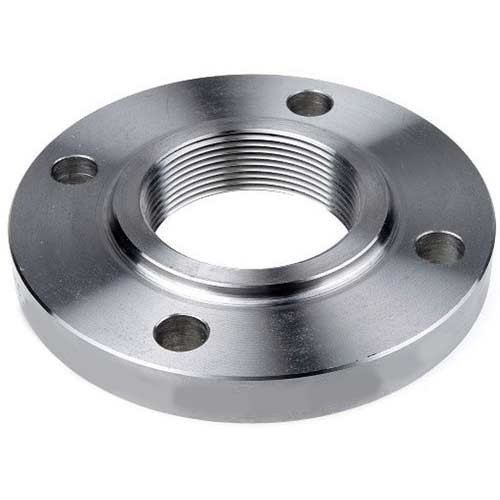
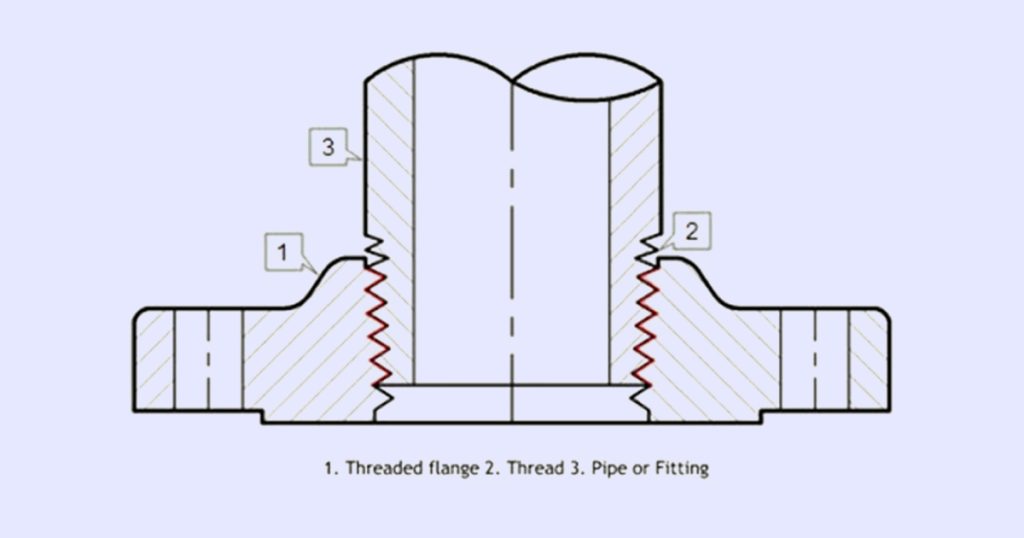
A threaded flange (also called a screwed flange) is a pipe component with internal threads that allow it to be screwed directly onto a pipe. It is the go-to choice for systems where welding is either hazardous, such as explosive environments, or impractical for maintenance reasons.
Comparison: Threaded vs. Welded Flanges
| Feature | Threaded Flange | Socket Weld / Weld Neck |
|---|---|---|
| Installation | Fast; only requires a wrench and sealant | Requires skilled welding and heat treatment |
| Safety | Ideal for explosive/flammable areas | High risk due to open flame/sparks |
| Best For | Low-pressure, non-critical air/water | High-pressure, high-temp critical systems |
| Fatigue | Poor under thermal cycles or vibration | Excellent stress distribution and durability |
The weight of a threaded flange depends primarily on its nominal size and pressure rating. As the pressure class increases (e.g., from Class 150 to Class 1500), the flange becomes significantly thicker and heavier to handle the higher stress.
Approximate Weights for Threaded Flanges (kg)
The following data reflects typical weights for forged carbon or stainless steel threaded flanges.
| Nominal Pipe Size (NPS) | Class 150 | Class 300 | Class 600 | Class 900 | Class 1500 |
|---|---|---|---|---|---|
| 1/2" | 0.4 | 0.7 | 0.8 | 2.5 | 2.5 |
| 1" | 0.8 | 1.4 | 1.6 | 4.0 | 4.0 |
| 2" | 2.3 | 3.3 | 4.2 | 10.0 | 12.0 |
| 3" | 4.1 | 6.3 | 8.5 | 14.0 | 21.0 |
| 4" | 5.9 | 10.2 | 17.5 | 24.0 | 32.0 |
| 6" | 8.4 | 17.5 | 37.0 | 47.4 | 65.0 |
| 8" | 13.0 | 26.5 | 58.0 | 75.0 | 105.0 |
| 12" | 29.0 | 52.0 | 115.0 | 155.0 | 255.0 |
- Calculation Note: Weights may vary slightly between manufacturers based on the specific hub height and material density (e.g., carbon steel at ~7.85 g/cm³ vs. stainless steel at ~8.00 g/cm³).
- Standards Compliance: Most industrial threaded flanges are manufactured according to ASME B16.5.
Key Weight Factors
Pressure Class: A Class 600 flange is often double the weight of a Class 150 flange for the same pipe size due to increased thickness.
Mahadev Dairy Pharma fitting +1
- Hub Design: Threaded flanges typically have a slightly heavier hub than slip-on flanges of the same size to provide enough material for internal threading.
- Material Density: Forged steel is the standard; however, specialized alloys like Inconel or Monel will have different weights due to their unique densities.
In the context of flanges, the term "schedule" (e.g., SCH 40, SCH 80) refers to the wall thickness of the pipe to which the flange will be attached. While blind flanges do not have a schedule (as they are solid disks), socket weld and threaded flanges must be compatible with the schedule of the connected piping.
Socket Weld Flange Schedule Considerations
For socket weld flanges, the "bore" (the internal opening where the pipe rests) is machined to match a specific pipe outside diameter, but the internal "bore through" (B1) usually matches the internal diameter of a specific schedule to ensure smooth flow.
| Nominal Pipe Size (NPS) | Pipe OD (inches) | SCH 40 Bore (B1) | SCH 80 Bore (B1) |
|---|---|---|---|
| 1/2" | 0.840 | 0.622 | 0.546 |
| 3/4" | 1.050 | 0.824 | 0.742 |
| 1" | 1.315 | 1.049 | 0.957 |
| 1-1/2" | 1.900 | 1.610 | 1.500 |
| 2" | 2.375 | 2.067 | 1.939 |
- Flow Compatibility: It is critical to match the flange bore with the pipe schedule. A mismatch (e.g., a SCH 40 flange on a SCH 80 pipe) creates a "step" inside the pipe that causes turbulence and accelerated erosion.
- Weld Neck Connection: While you asked about socket weld/threaded, note that Weld Neck flanges are the most schedule-dependent because their hub is butt-welded directly to the pipe wall.
Threaded Flange Schedule Requirements
Threaded flanges typically do not have a "bore schedule" in the same way because they use standard NPT threads. However, the pipe schedule determines the suitability for threading:
- Minimum Thickness: For high-pressure or high-temperature steam/water service, ASME B31.3 requires the pipe to be at least Schedule 80 to ensure there is enough wall thickness remaining after the threads are cut.
- Standard Service: For low-pressure utility lines (air/water), Schedule 40 pipe is often sufficient for threading.
Summary: Class vs. Schedule
- Flange Class (150, 300, etc.): Defines the pressure-temperature rating (how much pressure the joint can hold).
- Flange Schedule (40, 80, etc.): Defines the wall thickness compatibility (how well the internal diameters match).
Common Applications
- Utility Services: Low-pressure water, compressed air, and fire protection lines.
- Hazardous Environments: Fuel lines or gas systems where welding sparks could cause an explosion.
- Temporary Setups: Systems that need frequent dismantling for cleaning or reconfiguration.
Related Products
Request a Quote
Share your project requirements and our technical team will respond within 24 hours with the best solution.
Office Address
114, Sec-2 Geetanjali Nagar, Raipur, Chhattisgarh 492007, India
Phone Number
Email Address
Send an Inquiry
Tell us about your requirement for THEADED.